On February 5, 2026, a Doctoral Information Meeting was held in Room 228, Block 2 of the Institute of Information and Communication Technologies at the Bulgarian Academy of Sciences (IICT–BAS), dedicated to supporting early-career researchers in their academic and professional development. The event had a distinctly informative and practical character and focused on key aspects of doctoral researchers’ scientific careers, including research ethics, open science, scientific publishing, and bibliometric indicators. Through a series of thematic presentations and discussions, the meeting provided up-to-date information and practical guidance aimed at improving the effectiveness and quality of research activities.
As part of the forum, the presentation “Open Science and Its Benefits for the Research Community” was delivered by Silvi-Maria Gurova. The talk addressed contemporary trends and approaches related to transparency, accessibility, and the sharing of research outputs, highlighting the role of open science in the career development of doctoral students.
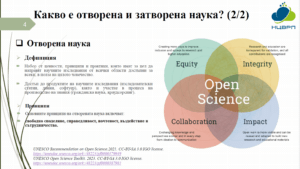
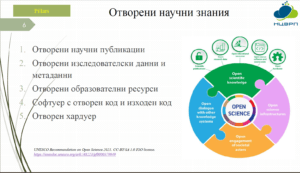
The presentation outlined the fundamental principles of open science as a model for the creation and dissemination of scientific knowledge, including a comparison between closed and open research practices. Particular emphasis was placed on open access to scientific publications, research data, software, and educational resources, as well as on core values such as collaboration, transparency, and reproducibility. The pillars of open science as defined by UNESCO were presented, together with the FAIR principles (Findable, Accessible, Interoperable, Reusable), which support effective research data management and reuse. In addition to the benefits, several challenges were discussed, including legal and ethical considerations, intellectual property issues, financial barriers to publishing, and the need for adequate research infrastructure.
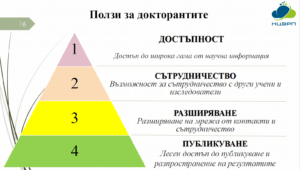
Special attention was given to the importance of Open Science for doctoral researchers. Open access to scientific resources facilitates the preparation of doctoral dissertations and research publications, enhances the quality and reproducibility of research results, and increases the visibility and impact of scientific contributions. At the same time, open science fosters international collaboration, expands professional research networks, and enables participation in joint scientific initiatives.
In conclusion, the presented topic emphasized the role of open science as a key factor in the development of the modern research ecosystem and in the successful professional advancement of early-career researchers. The Doctoral Information Meeting was reaffirmed as a valuable forum for the exchange of knowledge and good practices, encouraging doctoral students to apply the principles of transparency, research ethics, and collaboration in their future scientific work.